You now know what information exists and how your content fits the current supply. The next move is to study informational demand. If you know what people search for, you can ensure your content meets your audience’s needs and uses the language they use to find your product.
You can also identify the gaps between what people search for and what they actually find, and target those with your content strategy.
For “topical authority”, this graph shows the phrases that people who search for the term also search for — pulled from Google’s “people also search for” menu and / or Ads suggestions:
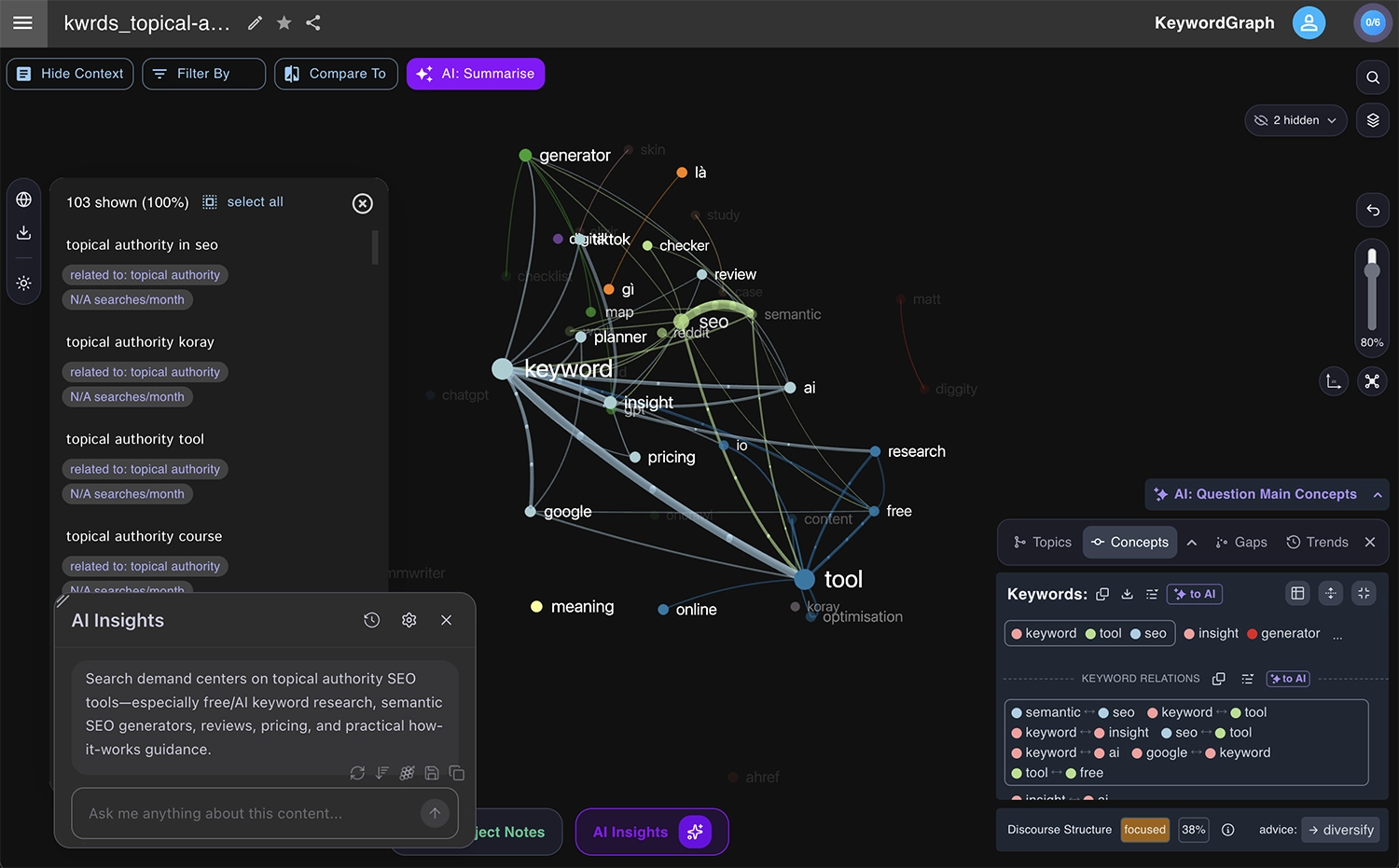
It automatically removed the search terms themselves (“topical” and “authority”), so the context around the queries is visible. The graph shows that “keyword research tools” is an important cluster. While “topical authority” is a key topic, it sits adjacent to the more traditional “keyword research tools” query. So content for people searching “topical authority” should also cover the more traditional “keyword research tools” (comparisons, information, and so on).
This is a great insight that modifies the strategy. Earlier stages said to talk more about “content quality”, “entity coverage”, and “metrics”; this shows we also need a whole section on traditional “keyword research” tools and techniques, because it still has better search volume than the newer clusters.