Co-occurrence is another key factor for LLMs and modern search engines: which terms appear near which others, in which contexts, across which sources. Brand mentions are one case, but the deeper principle is that any term you want to be retrievable for needs to co-occur — densely and across diverse sources — with the contextual vocabulary of the neighborhood you want to be retrieved from.
InfraNodus and KeywordGraph are structurally suited to this, because their graphs are built from word and entity co-occurrence — the same distributional principle behind how LLMs form associations. The SERP graph from Step 1 already shows the co-occurrence structure inside the top-ranking pages, but that maps the competitive landscape, not your position within it, and it draws only from ranked results — a filtered slice of the wider corpus LLMs retrieve from and train on.
So build a second graph: the co-occurrence neighborhood your brand and target terms currently live in. Analyze search results for your brand plus category terms (“[your brand] [target topic]”, “[your brand] vs [competitor]”). Snippets are usually enough, but you can also feed in URLs of articles, Reddit threads, podcast transcripts, and YouTube videos where the brand or methodology is discussed.
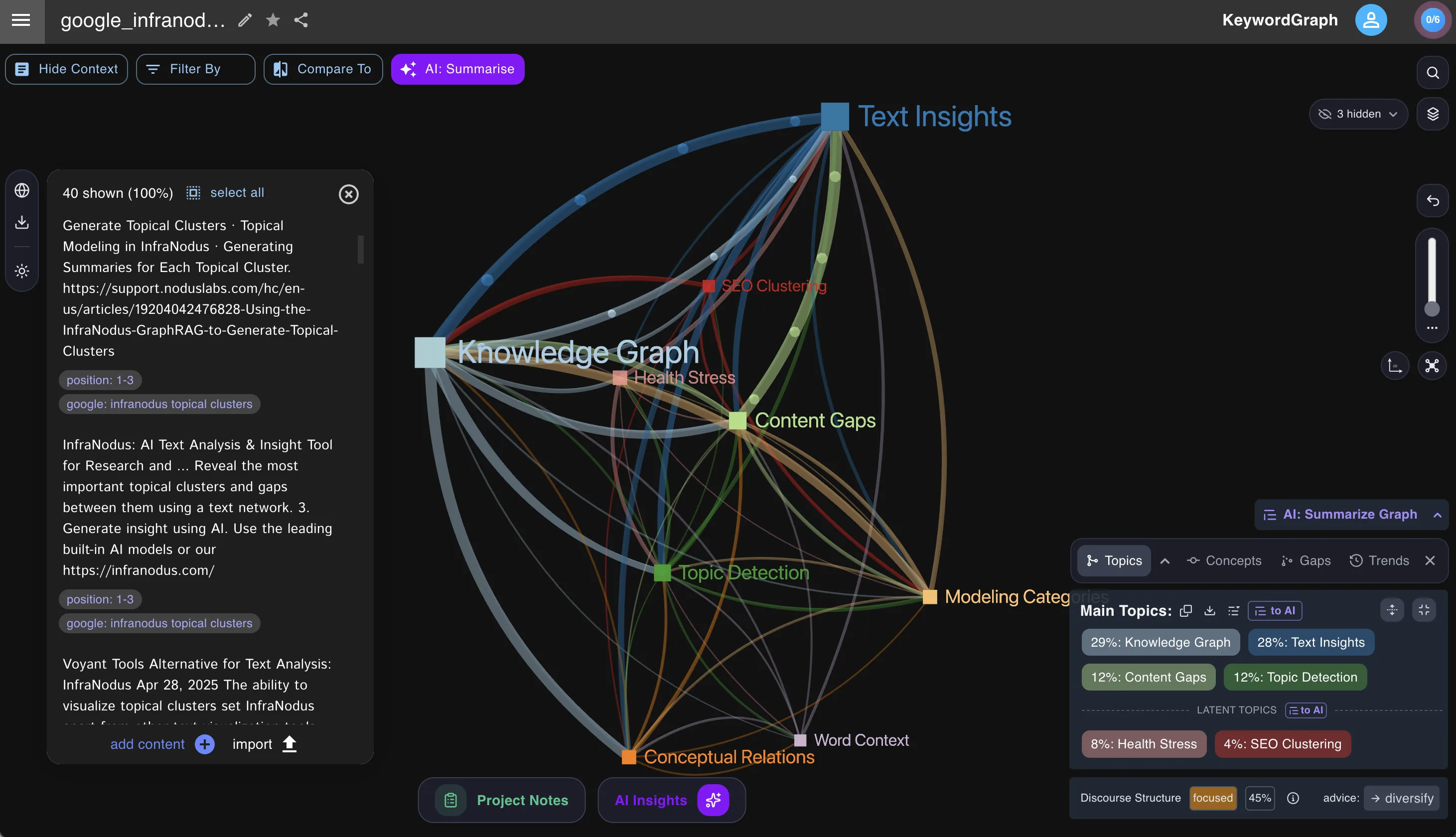
Comparing this brand-presence graph to the target SERP / intent graph reveals the seeding map: which topical clusters you are absent from but should be in, which adjacent clusters bridge to the ones you want to own, and which distinctive vocabulary needs to circulate more widely to densify your associations. Each missing relation is a context where a guest post, podcast appearance, expert quote, original research, or community contribution would shift your position toward the clusters that matter.
This is why distinctive vocabulary matters. A specific phrase you coin and use consistently acts as a handle: every time it appears it carries the associations you have built around it. Generic phrasing dissolves into the background distribution; distinctive phrasing creates retrievable structure.
In the example above, searching “infranodus topical authority” shows:
- Knowledge graph and text-insight clusters are prominent in how Google sees InfraNodus — a highly technical positioning for a niche audience.
- Yet Google’s and AI’s view of the topic itself (topical authority) is more focused on Authority Metrics, Content Quality, and Entity Coverage.
The implication: shift the positioning of the tool from a purely technical representation toward more business-oriented objects — increasing authority, various metrics, improving content quality, making sure relevant entities are covered.