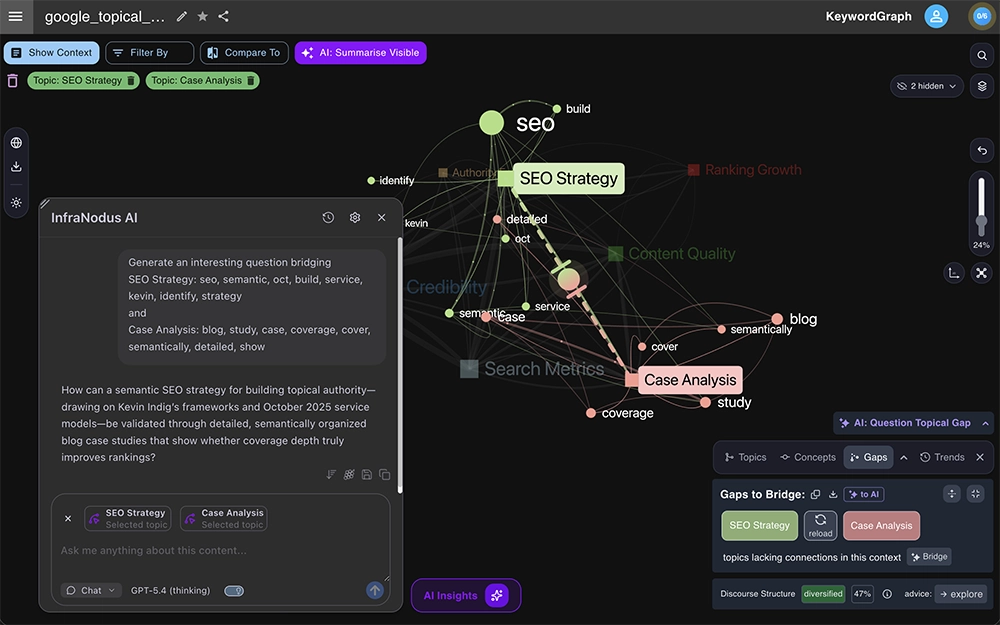
Use the search-results graph to find the gaps between topical clusters — ideas present in current discourse but not yet connected. Bridging them maximizes information gain.
Here you use the graph of search results generated in Step 1.3, but you focus on the gaps between topical clusters. These show what ideas are present in current discourse — content that ranks high with search engines and LLMs — but are not yet connected.
Targeting these gaps creates content that covers the blind spots in current supply. It is relevant because it covers important clusters, and novel because it bridges them in a new way. Google’s algorithm takes this novelty into account through the information-gain patent (most likely implemented in search), ranking pages that contribute something new — or that the user has not seen yet — above other results.
For our example, we identify the gap between the SEO Strategy and Case Analysis clusters:
A content gap between the 'SEO strategy' and 'case analysis' clusters — a place to add something new to the discourse.
We then use the built-in AI to generate a research question (usable as a prompt) as a starting point for content. In our case it proposes a case study linking the “topical authority SEO strategy” cluster to the “Case Analysis” cluster — showing how effective the topical-authority approach is in practice. A great idea for novel content.